
.svg)

The Greenhouse Gas Protocol is revising its Scope 2 Guidance, the most widely used framework for evaluating and reporting the carbon emissions of purchased electricity and heat. The revision includes updates to the market-based, guided by the principles of scientific integrity, impact, and feasibility of the methodology, in that order of importance.
However, the proposed changes, which include redrawn market boundaries and mandatory hourly matching of Energy Attribute Certificates (EACs), could severely limit the range of action for companies and harm a revenue stream that many clean energy producers rely on to support the profitability of new investments.
This article summarises the most important changes under discussion, the potential consequences, and what we believe should be amended to fulfil the purpose of the guidance.
Mandatory hourly matching
What does the current proposal say?
The Greenhouse Gas Protocol is moving from being flexible in the temporal correlation of contractual instruments — documents that prove the consumption of renewable energy consumption, such as Energy Attribute Certificates (EACs) — to mandating hourly matching, also known as 24/7 matching. The text reads: “All contractual instruments used for Scope 2 accounting shall be issued and redeemed for the same hour [as consumed].”
The proposal includes an exemption threshold based on organisations’ consumption volume (options include 5, 10, or 50 GWh annually) and/or the size of the reporting entity, with some companies classifying as SMEs. All entities below the threshold would then match their electricity consumption either monthly or annually.
The text also establishes a hierarchy for consumption data sources and contractual instruments, which include hourly EACs, hourly meter data from production assets, and facility-specific production profiles. You can see the breakdown in the table below.
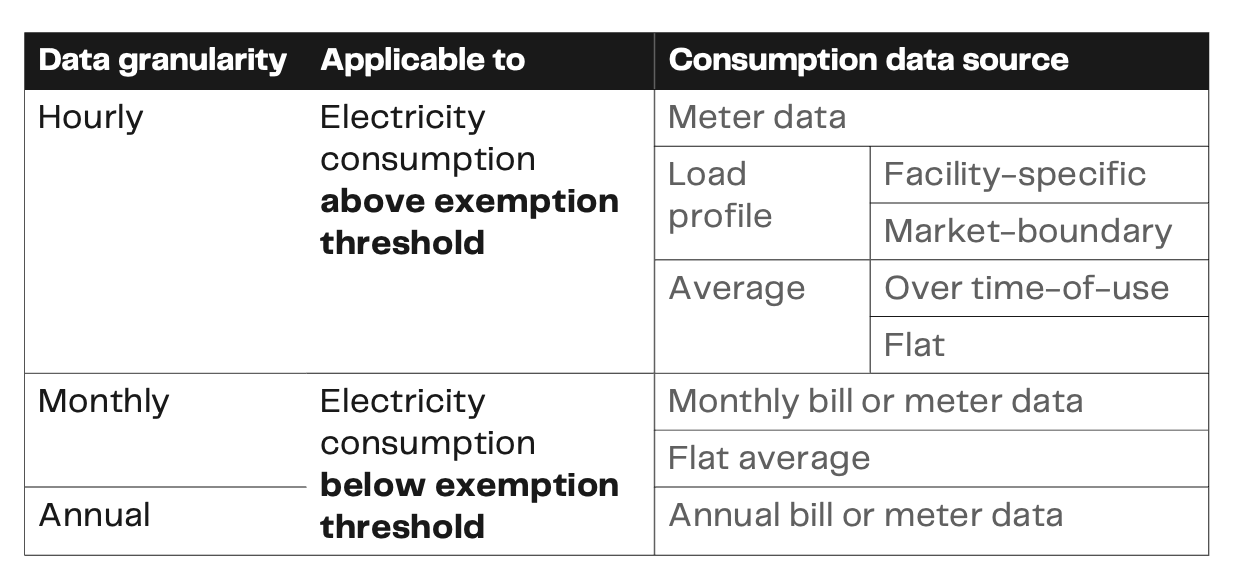
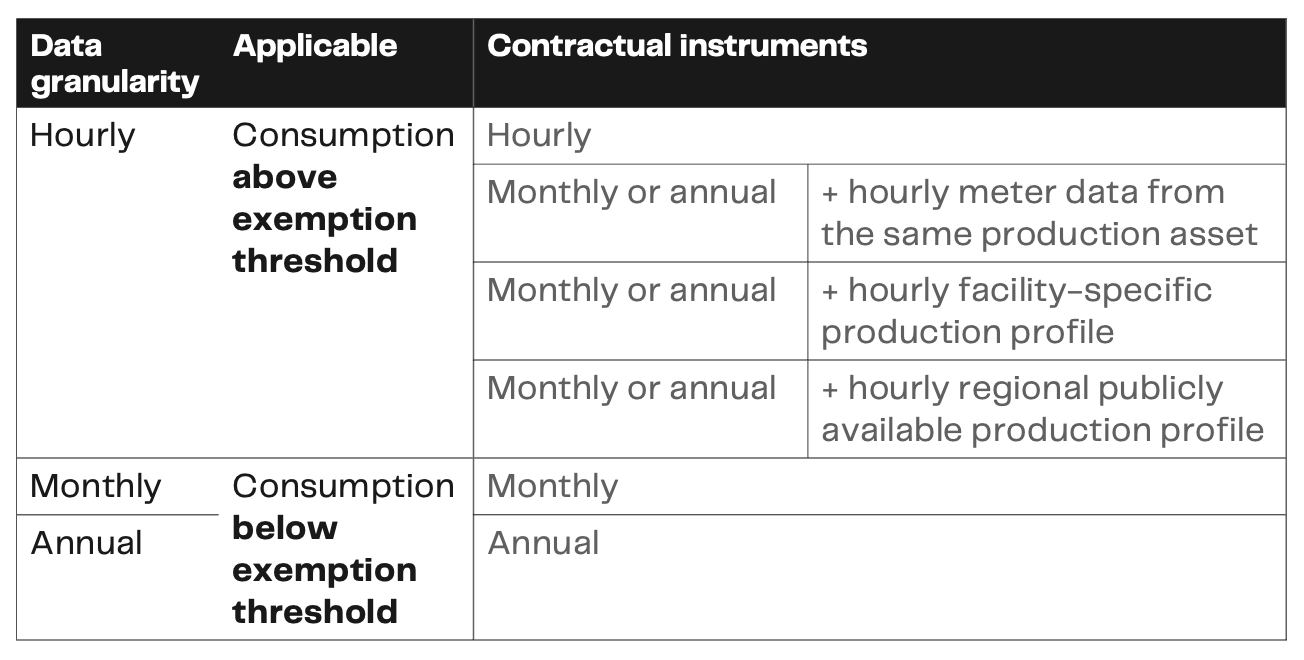
The proposal rests on two main arguments:
- Hourly matching reflects the type of energy being consumed more accurately. For example, solar energy is not produced or used at night.
- EACs should send a stronger demand signal for hours with low renewable energy production, strengthening the impact of the market incentive.
The problem with the current proposal
The GHG-P proposal misunderstands the purpose and impact of market-based energy tracking systems.
EACs systems were created to overcome the impossibility of tracking electricity flows, and they do not claim to mimic the behaviour of physical electricity. Rather, they track the environmental benefits of renewables, such as reduced emissions, and assign ownership of those benefits.
EACs and the spot market are meant to create different price signals. EACs represent the environmental attributes of clean electricity, while the spot market ensures electricity is delivered at the right place and time. Increasing the granularity of EACs does not necessarily improve said market signals, because:
- The exact time when electricity is produced is becoming less relevant due to the increasing use of batteries, meaning solar energy can be consumed at night. Also, there are currently no EACs adapted to the dynamics of grid-connected batteries.
- EAC matching is done ex-post, meaning after the corresponding volume of electricity is produced and the consumption data is available, creating no real hourly market signal customers can react to.
- The price of EACs should reflect the green production premium — which is not tied to the hour of production — not the costs of participating in the market.
- Mandatory hourly matching would greatly reduce liquidity in the EAC market, increasing volatility and reducing the green signal for producers.
- It would incentivise baseload demand from round-the-clock sources of energy, such as hydro and nuclear.
The current proposal also entails significant administrative burdens and complexity, which might discourage broader market participation. Some important barriers are:
- Hourly EACs do not exist, and most registries are far from being able to handle such granularity. Denmark, for example, launched hourly certificates on a trial basis but discontinued them shortly after.
- The GHG-P seems to assume that EAC system operators around the world will adapt to their standard. However, in Europe, for example, the EECS system Issuing Bodies are governed by EU and national legislation, meaning they will not prioritise the requirements of a voluntary reporting standard.
- Electricity producers would face such an increased administrative burden that they would need a dedicated team to manage certificate issuance, which nullifies the value of engaging in the process.
- Renewable electricity production is extremely difficult to predict on an hourly basis, making it impossible for companies to buy certificates in advance. Forward purchasing is a common practice in today’s market because it allows buyers to hedge their costs, often years in advance.
- Companies with highly stable consumption would be unduly favored by the new regime. All other companies with variable consumption would face administrative tasks — both from producing EACs and reporting exercises — so bloated as to make it unfeasible to follow the standard.
What is our counterproposal?
We suggest a gradual progression towards finer granularity that improves the quality of data in renewable energy claims, increases the impact of the market system, and ensures broad participation.
- Annual or monthly matching to be made mandatory, supporting incremental improvements within the existing infrastructure and adapting to the realities of each national registry.
- Hourly matching to be encouraged on a voluntary basis, keeping the proposed hierarchy for contractual instruments and meter data.
- A recommendation for companies for whom Scope 2 is a material issue to use hourly matching.
- A recommendation to disclose the level of granularity alongside RE claims (e.g., “matched on an annual basis” or “matched on an hourly basis”).
Deliverability and new market boundaries
What does the current proposal say?
The GHG-P has proposed new geographic limits for the use of market instruments that more closely “reflect the deliverability” of electricity, meaning “that electricity from a generator could plausibly be part of the mix serving the reporting entity through an electrically connected grid.”
The draft proposes different solutions in different regions of the world, determined along the lines of electricity pricing zones, physical grid interconnections, and other considerations. African countries, for example, are grouped into five power pools, while Europe is split into more than 40 bidding zones.
The proposal is driven by a critique of claims made across large, interconnected grids. For example, large power flows from Texas to California are unlikely, as are flows between Norway and southern Italy. It also aims to address bottlenecks, which undermine the credibility of cross-border electricity delivery claims.
The text under revision also includes two mechanisms to allow the cross-market use of contractual instruments, based on price differentials and the ownership of transmission rights.
The problem with the current proposal
The proposed changes do not increase the scientific integrity of renewable energy claims because:
- The concept of “deliverability” is not defined, and it is impossible to set market boundaries on a vague notion
- The criteria for defining the new boundaries are inconsistent across geographies for no readily apparent reason, meaning they lack a common scientific or logical foundation. .
- The cross-border exemptions are not good reflections of how grids are balanced and are very difficult to use in practice, especially when combined with the hourly matching requirement.
- Bidding zones are arbitrary delimitations for market pricing purposes that do not reflect the behavior of physical electricity flow. The proposal ignores that electricity flows across bidding zones.
- Power producers who already sell EACs across the new proposed market boundaries would be denied a source of income that is increasingly relevant for new investments, threatening the deployment of more renewable energy installations.
- Stricter market boundaries decrease liquidity, increase volatility, and provide a weaker green signal for producers.
- Knowing cross-border possibilities only ex-post severely limits their use, for example in cross-border PPAs, which have been one of the more successful tools in the European energy transition.
What is our counterproposal?
We propose using the principles behind the RE100 market boundaries globally. Unified markets must have:
- A direct physical interconnection: Not limited by national boundaries or bidding zones.
- Standardization of market-based systems: Comparable EACs must be used and mutually recognized by countries trading with one another.
- Aligned residual mix calculations: Increasing trust in market-based claims by aligning methodologies.
The revised standard must also accept the separation of the green price signal provided by EACs and the deliverability/availability market signals of physical electricity given by the spot price.
Scope 2 Public Consultation: purpose and deadlines
The Greenhouse Gas Protocol launched a public consultation on the Scope 2 Guidance to give all stakeholders an opportunity to contribute feedback on key topics related to the revision of the guidance.
The GHG-P is gathering feedback via a consultation survey available on its website.
The deadline for the consultation has been extended to 31 January 2026. A second public consultation on Scope 2 topics will follow in 2026, with final publication of the new standard expected in 2027.
Why companies using the Scope 2 Guidance should engage in the consultation
- This is a chance for standard users, market participants, and sustainability solution providers to influence the process. The opinions and experiences of large users and brands will not be easily ignored.
- The GHG-P places emphasis on the responses of corporate users of the standard. Many questions, including those on added reporting burden, are for corporate end-users only and those responding on their behalf.
- Users that later choose to contest the use of the GHG-P will be able to point to their prior arguments and advocacy.
- Electricity producers can provide valuable insights into the coexistence of the EAC and physical power markets, the impact of EACs on new investments, and whether the administrative burdens the revision entails are manageable and worth engaging with.
- Academics can help buttress the scientific integrity of the Scope 2 Guidance to ensure the solidity of the standard’s criteria and its real-world impact.
How can Ecohz help?
Ecohz has created a guide to the 180-question consultation survey that companies can use to write their responses. If you would like to receive the guide, get in touch at:
Madeleine Mowinckel: madeleine.mowinckel@ecohz.com
Ivar Munch Clausen: ivar.clausen@ecohz.com
Our advisors are also available to answer questions and provide any additional guidance companies might need to participate in the feedback process.


.png?width=3840&height=2560&name=Sun(1).png)

.png?width=3840&height=2560&name=Landscape_2(1).png)